




Originally published: August 2024 Last reviewed and updated: August 2026
Update note: This article keeps the original Amazon bullet point policy guidance and adds context from Amazon's 2026 product title update. The 2026 update is about product titles and Item Highlights, but it affects how sellers should organize listing content across titles, Item Highlights, bullet points, and descriptions.
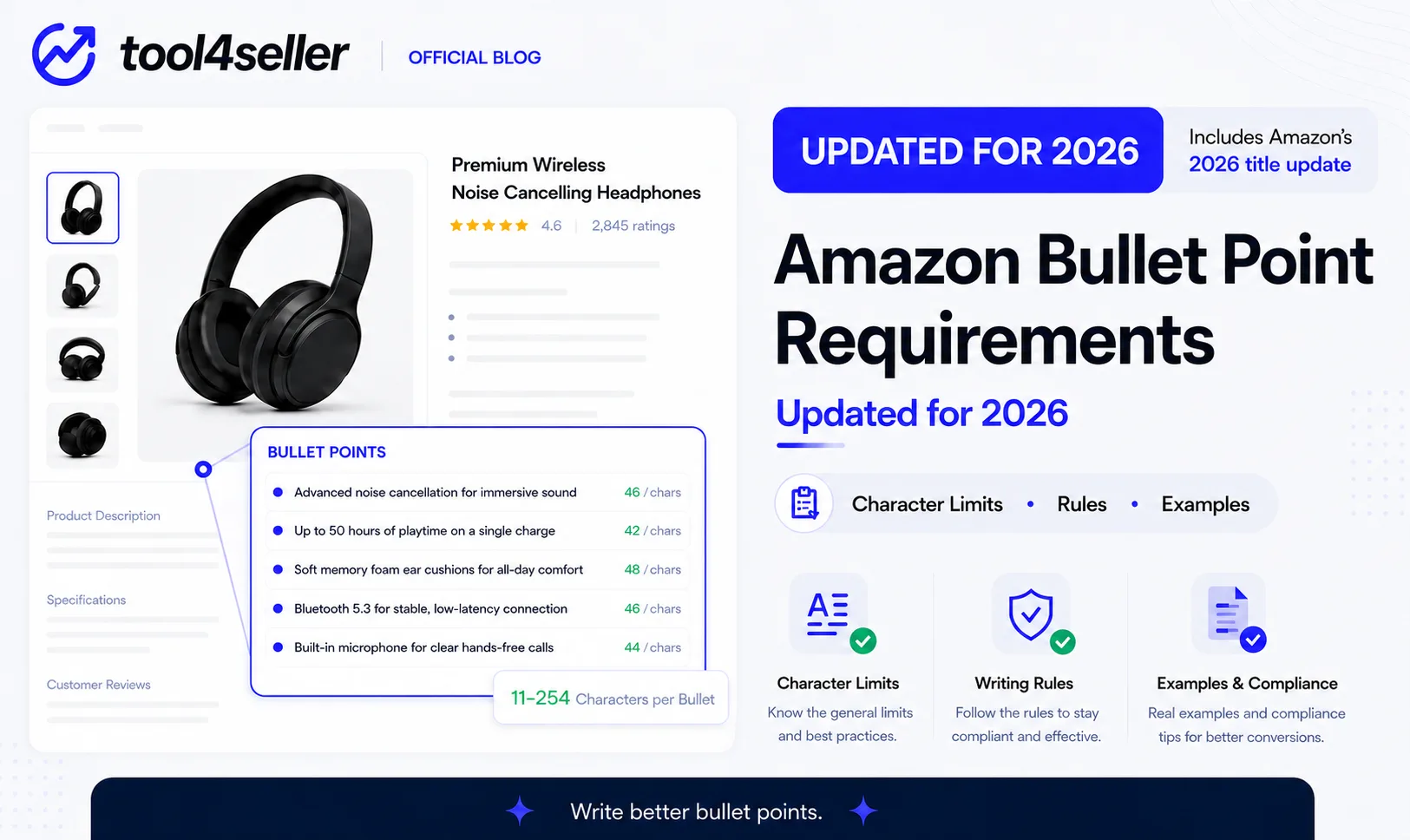
Quick answer: Amazon bullet points should generally contain more than 10 but fewer than 255 characters each. Use at least three unique bullet points, avoid prohibited symbols and claims, and verify any category-specific limits in the logged-in Seller Central help pages before making large listing updates.
Amazon Bullet Point Requirements: Quick Overview
Amazon bullet points, also known as key product features, highlight the main features and benefits sellers want customers to understand before buying. They help customers quickly decide whether a product matches their needs.
A compliant bullet point should be clear, product-specific, and easy to scan. It should explain real features and benefits instead of repeating the title, stuffing keywords, adding seller policies, or making unsupported claims.
In general, sellers should check that their bullet points:
- Include at least three unique bullet points
- Stay within the character limit shown in Seller Central
- Begin with a capital letter
- Use clear sentence fragments without end punctuation
- Avoid prohibited characters, emojis, unsupported claims, contact details, and refund guarantees
- Provide unique product information instead of repeating the same detail in every bullet
Amazon Bullet Point Character Limit
Amazon's Seller Central guidance says each bullet point should contain more than 10 but fewer than 255 characters. Each bullet should be long enough to provide useful information while remaining easy for shoppers to scan.
A good bullet point usually covers one clear idea. If a bullet starts to read like a paragraph, split the information across another listing field, such as the product description, A+ Content, Item Highlights where available, or another bullet point.
Character limits may vary by category, marketplace, product type, and the listing tools available to the seller. For bulk updates, check the current category guidance inside Seller Central before publishing changes across many ASINs.
How Many Bullet Points Should an Amazon Listing Have?
Amazon requires at least three bullet points. Many listings use five bullet points because that gives enough room to explain the product's most important features, materials, use cases, compatibility details, and buying information.
Each bullet point should add something new. If every bullet repeats the same keyword or the same benefit in slightly different wording, the content becomes less useful for customers and may increase the chance that Amazon removes or updates it.
A practical five-bullet structure is:
- Main product benefit
- Material, size, or construction detail
- Use case or customer problem solved
- Care, compatibility, or setup detail
- Package contents or important buying detail
2026 Update: How Product Title Rules Affect Bullet Points
In 2026, Amazon announced a major product title update that affects how sellers organize listing content. Starting July 27, 2026, Amazon said product titles in all categories except media must be 75 characters or fewer, including spaces.
Amazon also introduced Item Highlights, which provide an additional 125 characters for details such as materials or recommended use cases. Amazon says this content is searchable and visible with titles in search results and on product detail pages.
This 2026 update is not a replacement for Amazon's bullet point requirements. It is a product title and Item Highlights update. However, it directly affects bullet point strategy because sellers can no longer rely on long titles to carry every keyword, feature, use case, and product detail.
For sellers, the practical adjustment is to keep each listing field focused on its job:
- Title: Keep the product identity clear and concise, usually brand, product type, and the most important differentiator
- Item Highlights: Move extra searchable details such as materials, use cases, or comparison-friendly information into the new 125-character field where available
- Bullet points: Explain unique product features, benefits, materials, compatibility, care instructions, setup details, and buying reasons
- Description or A+ Content: Use longer-form space for product story, expanded use cases, and supporting details
Amazon also said sellers can go to Manage All Inventory, select Edit for a listing, and use View enhancements to see title and Item Highlights recommendations that follow product title requirements and best practices. These recommendations keep key product information in the title and move additional details to Item Highlights.
After July 27, titles that are still over 75 characters may be gradually updated to Amazon's AI recommendation. Listings are expected to remain active during this process, and sellers can edit titles and Item Highlights at any time. When Amazon makes changes, brand owners have 14 days before implementation to review, modify, and approve AI-generated recommendations in Review Listings Changes.
The main takeaway is simple: shorter titles make compliant bullet points more important. Sellers should use bullet points to make the remaining product details clear, useful, and non-repetitive.
Allowed and Prohibited Content
Amazon bullet points should focus on the product itself. They should not be used for seller contact details, external links, refund promises, unsupported claims, or decorative formatting.
Do not include content such as:
- Special characters such as trademark symbols, registered marks, currency symbols, decorative marks, or unsupported symbols
- Emojis such as smiley faces, checkmarks, crosses, or decorative icons
- ASINs or placeholder terms such as NA, N/A, not applicable, not eligible, TBD, yet to decide, to be decided, or COPY PENDING
- Prohibited or sensitive phrases such as eco-friendly, environmentally friendly, ecologically friendly, anti-microbial, anti-bacterial, made from bamboo, contains bamboo, made from soy, or contains soy, unless current Amazon rules and category requirements explicitly allow the claim
- Guarantee or refund language such as full refund, if not satisfied send it back, or unconditional guarantee with no limit
- Company information, website links, external hyperlinks, email addresses, phone numbers, or other contact information
- Repeated information that does not add unique product value
Claims should also be handled carefully. Avoid subjective, comparative, award-based, survey-based, environmental, health, safety, or performance claims unless they are accurate, verifiable, and allowed under the relevant Amazon rules for the category.
Formatting and Writing Requirements
High-quality bullet points should be written for shoppers first. They should be easy to read on mobile, consistent across variations, and specific enough to help customers compare products.
Amazon's writing guidance includes:
- Begin with a capital letter
- Write as a sentence fragment
- Do not use end punctuation
- Use semicolons to separate short phrases when needed
- Write numbers one to nine in full, except in model names, measurements, or technical details
- Add a short header and use a colon before the main detail
- Include a space between a number and a unit, such as 60 ml
- Avoid keyword stuffing, unnatural repetition, and long strings of search terms
- Keep variation information consistent across colors, sizes, packs, and styles
- Do not refer shoppers to products outside the current ASIN
Why Amazon May Remove or Update Bullet Points
Amazon may remove or update bullet points when the content does not comply with product detail page rules or bullet point requirements. Common triggers include prohibited characters, emojis, unsupported claims, refund guarantees, external links, contact details, placeholder text, and repetitive content.
Amazon has also stated that it may use generative AI to optimize listing quality. Non-compliant content may be removed, and AI may be used to generate compliant, higher-quality bullet points. Any AI-generated quality-related improvements may be shared with sellers for review before they are published to listings.
For sellers, this means bullet points should be reviewed proactively. Waiting until content is removed can lead to missing product details, weaker conversion copy, or unexpected listing changes.
Compliant vs. Non-Compliant Bullet Point Examples
| Compliant | Non-Compliant |
|---|---|
| Stainless Steel: Made from food-grade stainless steel for daily drinking, commuting, and gym use This works because it starts with a clear header, describes a product feature and use case, and avoids unsupported claims or decorative formatting. | BEST ECO-FRIENDLY BOTTLE - Full refund if not satisfied!!! This may be rejected because it uses promotional language, includes a sensitive environmental claim, relies on guarantee language, and does not give specific product information. |
| Color Options: Available in black, blue, and white to match daily use or gifting needs This keeps the focus on product information and gives shoppers a useful buying detail. | Visit our website for more colors, best price, and warranty details This may be removed because bullet points should not include external links, seller contact direction, or promotional pricing language. |
What Changed in the August 15, 2024 Update
Amazon's August 15, 2024 bullet point update focused on simplifying and improving product detail pages for customers. The original update highlighted restrictions on special characters, emojis, certain phrases, and refund-related guarantees.
The update also emphasized high-quality bullet points that are clear and concise. Standardized bullet points help customers find key features and benefits more easily, compare products faster, and make more informed purchase decisions.
Although the update became effective in 2024, sellers should continue treating the requirements as active listing compliance guidance. The 2026 title update adds new pressure to organize listing information more carefully, but it does not remove the need for compliant bullet points.
Official Amazon Sources and Last Review Date
This article was last reviewed in August 2026 against Amazon's public Seller Central guidance and Seller Forums announcements. Sellers should confirm details in their logged-in Seller Central account before applying changes at scale.
- Amazon Seller Central: Product bullet point requirements
- Amazon Seller Forums: Review updated bullet point requirements to optimize your listings
- Amazon Seller Forums: Updates to improve your product titles begin on July 27
Frequently Asked Questions
What is the Amazon bullet point character limit?
Amazon's Seller Central guidance says each bullet point should contain more than 10 but fewer than 255 characters. Category-specific rules may vary, so sellers should confirm the applicable limit in their logged-in Seller Central account.
How many bullet points should an Amazon listing have?
Amazon requires at least three bullet points. Many sellers use five bullet points to cover the product's most important features, benefits, materials, use cases, and buying details.
What characters are prohibited in Amazon bullet points?
Amazon restricts certain special characters, decorative symbols, and emojis. Sellers should avoid trademark symbols, registered marks, currency symbols, checkmark emojis, face emojis, and other decorative characters unless current Amazon guidance allows them.
Why were my Amazon bullet points removed?
Bullet points may be removed or updated if they include prohibited content, unsupported claims, refund guarantees, external links, contact information, repetition, placeholder text, or other content that violates Amazon product detail page rules.
Can Amazon change bullet points using AI?
Yes. Amazon has stated that it may use generative AI to optimize listing quality and generate compliant bullet point improvements. Quality-related AI updates may be shared with sellers for review before publication.
Do bullet point limits vary by category?
Yes. Some limits and listing requirements may vary by category, marketplace, or product type. Always check Seller Central for the current rule that applies to your listing before making bulk edits.
Does Amazon's 2026 product title update change bullet point requirements?
The 2026 update is mainly about product titles and Item Highlights, not a direct replacement for bullet point rules. However, because most non-media titles must be shorter, sellers should use bullet points more carefully to explain product benefits and details that no longer fit in the title.